The Authentication Cliff
Nov 3, 2025
The cost of truth has inverted. The default response is a surveillance state. Here is the alternative.
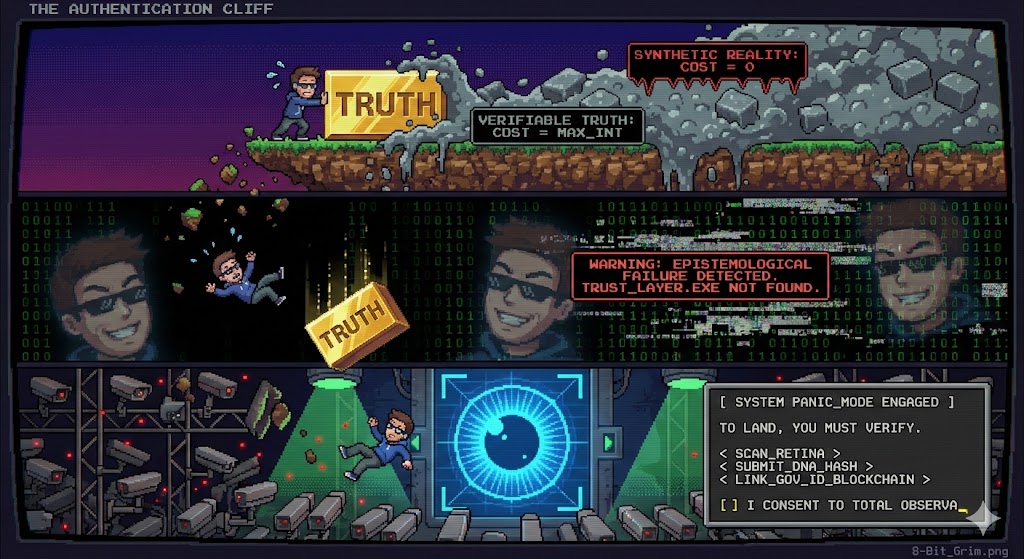
We are debating AI safety in the wrong language. While the discourse fixates on superintelligence and existential risk, a more mundane and urgent catastrophe is unfolding: the collapse of verification.
I work in trusts, estates, and cross-border tax compliance—the plumbing of how value moves across jurisdictions. My job is verification. The systems I rely on are held together by a single, unexamined assumption: that creating a plausible fake is expensive enough to keep fraud manageable.
That assumption is dead.
The Cost Curve Inversion
Here is the mechanism of the collapse:
Generation is approaching zero cost. AI allows bad actors to synthesize identity—voice, documents, history, behavior—at scale.
Verification is approaching infinite cost. Distinguishing signal from noise is becoming impossible for banks, courts, and employers.
When these curves cross, institutional trust inverts. A bank cannot perform KYC; a court cannot trust evidence. Systems that rely on "prove who you are" cease to function.
The Default: The Administrative Panopticon
When institutions cannot verify trust, they demand transparency. Not because they desire a panopticon, but because "log everything and sort it out later" is the administratively easiest response to a crisis of truth.
If we cannot distinguish the real from the fake, the only remaining tool is total legibility. Bind every digital action to a biological passport. Create permanent, cross-border audit trails. This is already the logic behind FATCA, CRS, and emerging digital identity mandates.
We are not choosing surveillance. We are defaulting into it because we have not built an alternative.
The Cliff
This is the Authentication Cliff. On the other side, we face a binary choice:
Omniscient Surveillance: The cost of participation is permanent exposure.
Institutional Collapse: Trust-based systems fail.
There is a third option: Infrastructure we haven't built yet.
It is possible to prove facts—age, solvency, authority—without revealing identity. The cryptography exists (zero-knowledge proofs, verifiable credentials). The legal infrastructure does not.
That is what I am building. Over the next five posts, I will outline a new architecture for digital trust—one based on liability rather than surveillance—and the legislation I am drafting to make it real.